
Z is for Zed
Letter from a Canadian

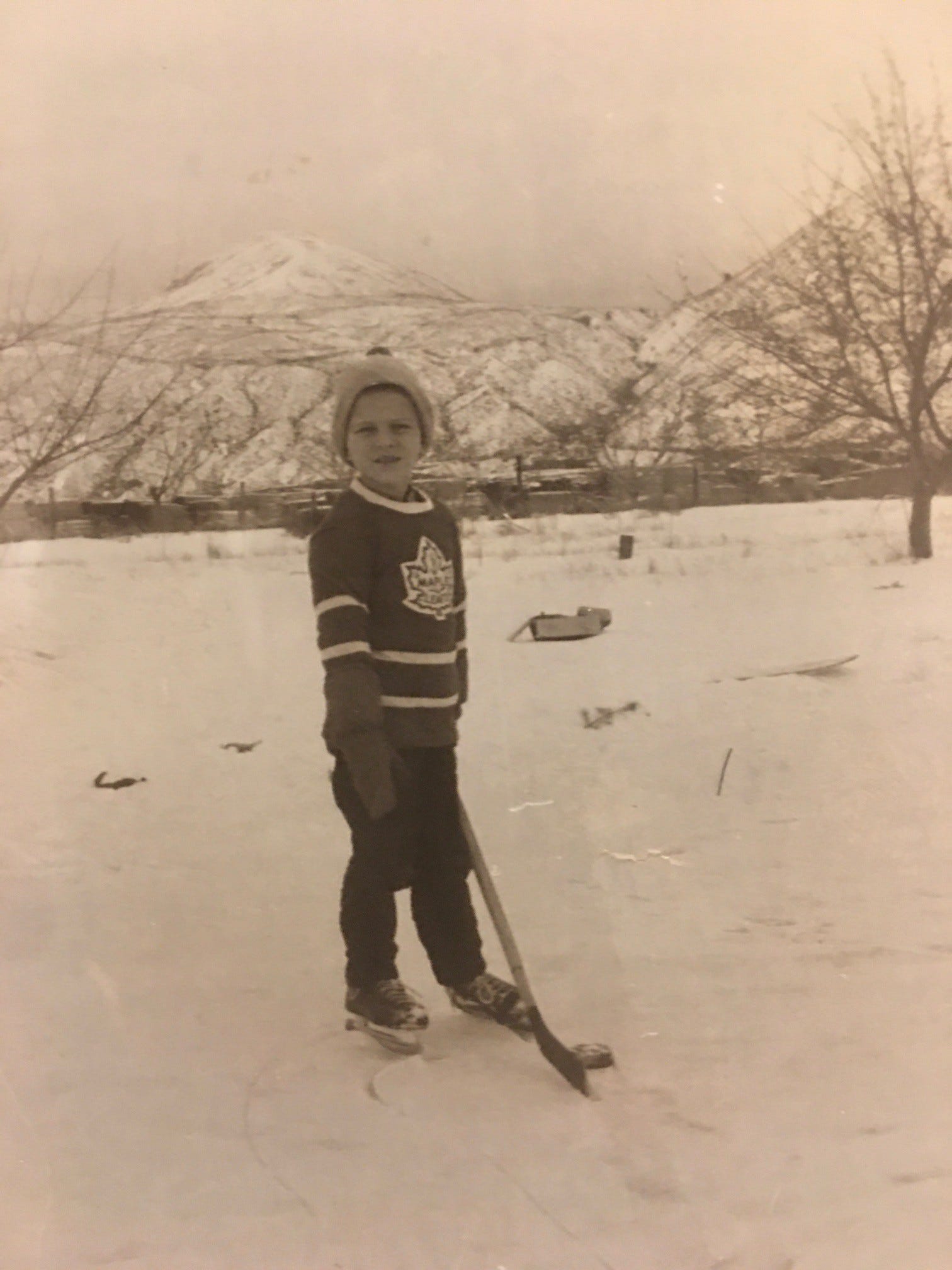
(North Kamloops, British Columbia, winter of 1963-64).
Growing up in British Columbia, the United States was our freer, more exciting neighbour. People now think of Vancouver as a worldly, cosmopolitan city, but in the 1960s it was still, well, provincial. My first real visit to the States was in 1967, our family drove to San Francisco. I remember it really well. Hippies. My little sister and I had never actually seen an African-American person up close before - we were chided by our parents for staring in wonder. After that, in summers our family would, with other Canadian friends, rent cabins just over the border in a place called Birch Bay. It had real bars, open on Sundays even, with live country music, and my parents loved that.
Crossing the border was easy. When I was seventeen I drove to Seattle to see Paul McCartney in concert, and it was a thing you could do, no passport needed. My friend, also a Mike, and I would go for weekends to catch a pair of Mariner’s games. As undergraduates we would drive to Southern California for spring break (not crazy Gulf of Mexico types of spring break, we were still Canadians, after all) and set up tents at a state campground by the beach just north of Malibu.
When I was twenty-one I began a Masters degree in Ontario, and I drove (alone) the American route because my mom’s sister and her family had moved to Minnesota, and I could stop in and see them. Driving over the badlands and prairie, even eastern Montana was something thrilling, an adventure.
I grew up with an affection for the US, which has never abated. It’s an open, energetic country.
Thirteen years of teaching in Saskatchewan wore me down - it’s not much comfort when it is forty below to tell yourself that at least it’s a dry cold - and so with some professional ambition I moved to the US. I spent four years in Atlanta, which was not a good match, and in 2006 came to Bloomington, where I’ve stayed, and will stay: this is it.
In political sociology terms, I changed from being an “Anywhere” to a “Somewhere” (these inclinations are not innate), becoming immersed in this small city (or big town), making friends, finding favourite places, contributing to the community where I can. I remarried here, raised my children and step-children here, and even as they are in that young-adult first stage of exploring the world as independents, my wife and I keep to this place, our home, but also a home base for them.
I’m not sure how many Americans realize the effect that the past few months of Trump has had on Canadians, even when they are generally sympathetic with us. It is not about the slogans, “America First” or “Make America Great Again”. All political slogans are banal, no matter where you look. And that a country’s president or prime minister would put their own country’s interests first is hardly surprising - it’s their duty, really - though Trump has a faulty, to say the least, understanding of what sorts of policies will in the end advance American interests.
And it is not even the actual policies, such as they are. Trade wars are really dumb, self-inflicted wounds, but Trump is not the first protectionist politician to come along (it used to be a much more common position on the left - conservatives were the free-traders forty years ago). Government in Washington is (deliberately) in a state of chaos, but he’s doing what he said he would, and what the majority of voters chose: massive cuts to government spending and “DOGE” were campaign promises, not some surprise he has sprung upon us. This is not about the unhinged notion that randomly applied, then reversed, then applied anyway tariffs are the path to industrial greatness, or that the fracturing of international alliances is a path to greater security, or that randomly firing those workers who administer public services will bring greater efficiency.
It’s something else. The “Make Canada the 51st state, ‘Governor Trudeau’, it isn’t a real country anyway, I don’t know anything at all about the place but we will just redraw the borders, which are imaginary anyway” thing.
It is about not taking Canadians seriously as Canadians, as a people with a real country they love, whose identity is in part little things like how to spell colour and theatre, but big things as well. English-speaking Canada (though this does not apply to Quebec) has never had a strong sense of “nationalism” (although all the way back in 1963 George Grant, in Lament for a Nation, wrote that this might come to harm Canada eventually, and I sense he was right), but it does have what George Orwell defined as patriotism: “devotion to a particular place and a particular way of life, which one believes to be the best in the world but has no wish to force on other people.” And about which people will be very defensive. All my life it would have been laughable for Canadians to talk about what an American military invasion might look like. I still don’t think it’s likely, but it’s not something any Canadian laughs about anymore.
What Trump has done, and readers might have had this unhappy experience at a personal level at some point in their lives, is to tell Canadians:
“You thought you had a certain kind of relationship with us, you thought we were mutual friends, albeit one of us bigger and richer than the other, you thought we respected you, found a little bit endearing your quirky differences. But we don’t think about you that way at all. We think you are just kind of pathetic, dependent on us without being willing to ever admit it. We’ll threaten you if we like, because, after all, what are you going to do about it?”1
You say something like that, and you permanently change the relationship. If it were just Trump, it might be excused as “it’s just him being him. Look at the way he regards Ukrainians, Palestinians, Mexicans - he disrespects everyone.” Sure. But there are too many of his supporters, the tens of millions who voted for him, going along with it, treating Canada as something of a joke. I have yet to see a single Republican politician tell him to back off when it comes to insulting Canada. I don’t see this being forgotten by Canadians for a very long time, if ever.
Canada is not a perfect place; no place is a perfect place. It has been governed with complacency and an inability to make hard choices, its leaders make fine statements about global cooperation yet often have the country take on the role of a free rider. But it is every bit a “real” country as any other, loved by its people, sometimes with a bit of exasperation, but loved nonetheless.
Some migrants to the US are looking to leave. Everyone has a different situation, and I won’t judge anyone who leaves or stays (unless they start to get all judgmental about people who choose differently).
I’m staying. This is home now. I will try to fight for good things and oppose bad things, and stand with my American family and friends.
I play in a folk band with friends in town; like Neil in CSNY I guess I give us a Canadian flavour. We play Gordon Lightfoot and Neil Young, Bob Dylan and Tracy Chapman, sing “City of New Orleans” and “Four Strong Winds.” Cross-cultural understanding and all that. Canadians write good songs, and care deeply about their country. My family and friends understand that - I hope eventually more people do, eh?

That Canada has actually responded, with vigour, seems to have left him quite surprised.
This has been a great series, and what a poignant end to it. Thank you.
What exactly does Orwell mean in his "Notes on Nationalism" when he writes that "one believes [one's country] to be the best in the world"? I am always annoyed when I hear people claim that Canada is "the best country in the world", because I think listeners often take this mean that it is the best in some absolute sense.
I don't think that about Canada, or any other place, even though there is nowhere else I want to live, or could live and still feel 'at home'. (The culprit is my "devotion to a particular place and a particular way of life".)
Canada is the best country in the world for me. But people born in lots of other countries are just as devoted to their particular places and ways of life. I could potentially have been just as content had I been born in those places.
This is what Orwell must be referring to when he says that patriots have "no wish to force [their particular place and way of life] on other people". The patriot recognizes that people in other countries can be patriots too.
It has been a bit shocking to hear a MAGA blowhard on Fox 'News' tell Ontario Premier Doug Ford that he [the blowhard] feels personally offended that Ford has less than no interest in accepting the honour of American annexation and citizenship. Apparently, this reflects the blowhard's narrowminded belief that the United States is, in some absolute sense, "the best country in the world". Ford is implicitly denying it, thus causing the snowflake to have hurt feelings. (Clarification: Canadians like snowflakes, in the reasonable quantity, but not snowflakes in this sense.)