
Y is for Youth
Does anybody remember laughter?


(It’s a cliche to use 1990s images of happy young people goofing off and say “see, no smart phones!” but I’m doing it anyway).
Here is a (paywalled, sorry) article from The Economist, December 16, 2010, on “The U-bend of Life”. It is about what was something of a stylized fact about how happy people feel over their life-cycles, recognizing that some people spend their entire lives either more or less happy than everyone else. Here is the key figure:
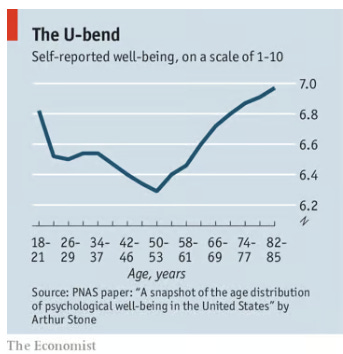
which is taken from this paper. In brief: we begin adulthood pretty happy, things get worse until about age 50, and then track upwards again.
From The Economist:
Mr [Peter … “hope I die before I get old, etc.”] Townshend may have thought of himself as a youthful radical, but this view is ancient and conventional. The “seven ages of man”—the dominant image of the life-course in the 16th and 17th centuries—was almost invariably conceived as a rise in stature and contentedness to middle age, followed by a sharp decline towards the grave. Inverting the rise and fall is a recent idea. “A few of us noticed the U-bend in the early 1990s,” says Andrew Oswald, professor of economics at Warwick Business School. “We ran a conference about it, but nobody came.”
Since then, interest in the U-bend has been growing. Its effect on happiness is significant—about half as much, from the nadir of middle age to the elderly peak, as that of unemployment. It appears all over the world. David Blanchflower, professor of economics at Dartmouth College, and Mr Oswald looked at the figures for 72 countries. The nadir varies among countries—Ukrainians, at the top of the range, are at their most miserable at 62, and Swiss, at the bottom, at 35—but in the great majority of countries people are at their unhappiest in their 40s and early 50s. The global average is 46.
That was 2010.
Here is some research from 2024, also by David Blanchflower, and others, in the NBER Working Paper “Further Evidence on the Global Decline in the Mental Health of the Young”:
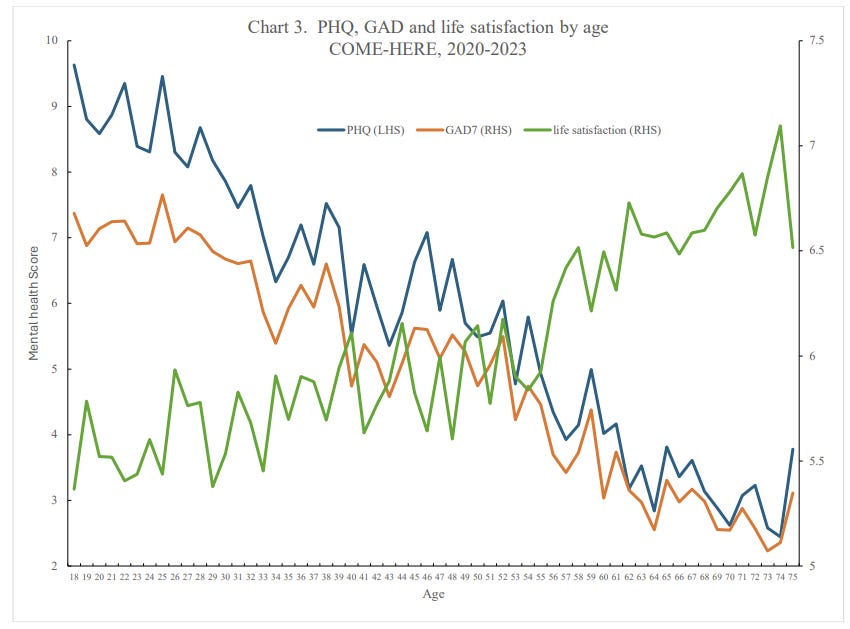
The green line is “life satisfaction”, what in 2010 was thought to be U-shaped over the life cycle and now, through multiple surveys, methods, and countries, is not; it simply rises with age as of this moment. PHQ, the blue line, is the incidence of depression, and GAD, the orange line, captures anxiety. Young people are, relative to all of their elders, less happy, more depressed, more anxious. The U is history.
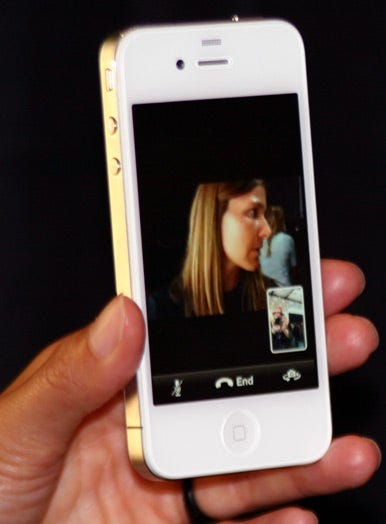
This is the iPhone 4, released in 2010 (the first iPhone was in 2007). The iPhone 4 introduced the front-facing camera. In 2012 Mark Zuckerberg bought Instagram. If you are teaching undergraduates this year, they have had these options, if their parents allowed (or, with social media, didn’t allow but could not enforce) since they began elementary school. Was this the beginning of the end of youth happiness, combined with severe rises, especially for girls, in mental health disorders?
Here is a chart from another paper by Blanchflower, again from 2024, this one focusing just on the UK:
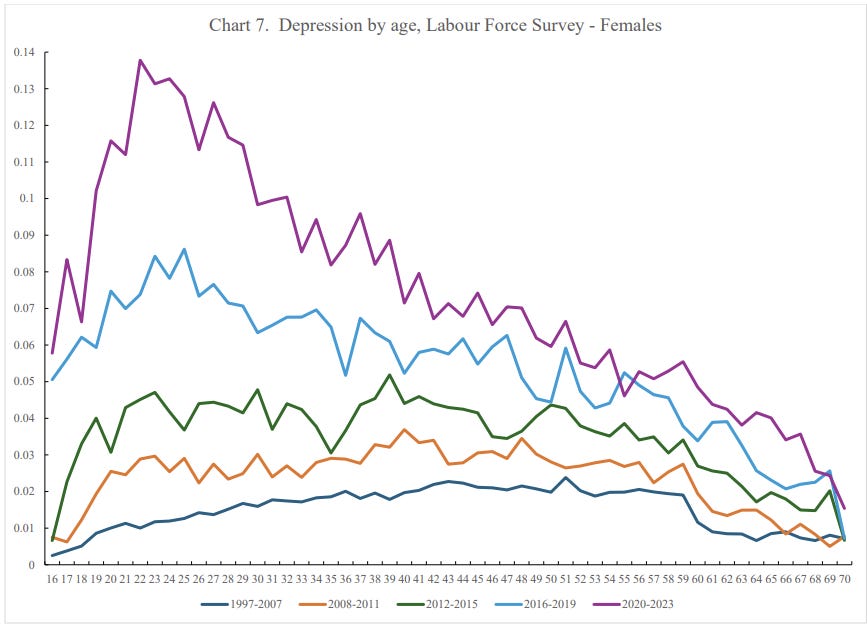
Seventy-year old women have had the same rates of depression for the past 25 years or so: all these lines converge. But the rates of depression among young women rose in 2012-2015 (green line), then even more in 2016-2019 (blue line), and then even more 2020-2023 (purple line).
In The Anxious Generation, Jonathan Haidt lays the blame on the smart phone, the front-facing camera, and social media, which have brought all sorts of harms into childhood and teenaged development, especially, but not only, for girls, as well as coming with the opportunity cost of young people not spending time doing those ordinary things (hanging with friends, exploring, playing games, taking risks, forming deeper relationships) that build our mental and social capabilities. We carry addictive distraction-devices around with us, and even when they are in our pockets or facing downwards on our table we know they are there. Social media posts to strangers, who read them asynchronously, generate anxiety over whether we will be liked, reposted. Vicious comments from strangers are everywhere. For teenagers, on average (there are exceptions) this is not a place to be that is going to generate happiness - it is a place of anxiety over how you live, and how you look.
Why are the effects of social media worse for girls? Haidt:
Girls are more sensitive to visual comparisons, especially when other people praise or criticize one’s face and body. Visually oriented social media platforms that focus on images of oneself are ideally suited to pushing down a girl’s “sociometer” (the internal gauge of where one stands relative to others). Girls are also more likely to develop “socially prescribed perfectionism,” in which a person tries to live up to impossibly high standards held by others or by society.
Before smart phones there were the internet and desktop computers, and we had flip-phones, sure. But we didn’t carry the internet in our pockets, and flip-phones are just phones, with (not awfully convenient) text capabilities to friends and family (research has found that being able to text and face-time your friends is actually not that bad a thing for teenagers - it’s all the other stuff in their phones that’s the problem). Their brains are still forming, and the smart phone plus social media, apps designed by their owners to be addictive, are bad.
When I saw David Blanchflower give a workshop presentation earlier this year, he said, yes, he thinks Haidt is correct: there has been too much of a shock to trends in young people’s well-being that occurs right at 2010 - 2013, and not just in the US,1 for it not to be related to the major change in how we all now live.
I think the evidence is too strong to ignore, recognizing that there is a lot of room for further research (see this from Candice Odgers and Michaeline Jensen for a more skeptical view regarding what Blanchflower and Haidt are claiming). I’m old enough to have lived through various panics about dangers to teens from too much tv, from evil rock lyrics, from even more evil rap lyrics, etc. etc. But this is different: overreactions in the past don’t mean that forever after there is nothing really to worry about. In this case, there is.
What to do? Haidt gives four, low-cost, recommendations, though they require agreement and coordination: it is hard for any individual parent to deny their kids something that all the other kids are doing (evidence suggests that kids without smart phones suffer when everyone around them has one: it just leaves them isolated). So:
No smartphones before high school
No social media before 16
Phone-free schools
Far more unsupervised play and childhood independence.
As I write this I am just back from my gig tutoring math at our high school. Students are allowed phones, but they are not to be taken out in class. But wow do these kids want to check their phones! Every moment where there might be a chance to have a peek, undetected, they are on it. It turns out to make a huge difference if their phone is not in the same room, or at least in a box they drop their phones into as they enter the classroom - after a bit they forget about it, and maybe devote some concentration to Algebra. I’m not a teenager (to say the least), but I have found that if I really want to concentrate on something, leaving my phone in another room helps.
This is supposed to be an arts policy blog, so what can be said on that front? I have a few ideas.
First, allowing children and teenagers chances to do fun things, without adult supervision, and without smart phones, is a good thing.
Your child really likes taking pictures? Check out offerings for a decent, used, actual camera, and encourage the hobby (this includes letting them go outside on their own and seeing what they can see - they are not going to be kidnapped).
Get them a card for your local public library, and encourage them to go there, on their own, and to your local used book store as well (including those in thrift shops - good deals there) to find what they can find. Encourage exploration, give occasional advice, but don’t be annoyed if they don’t take it, let them follow their arrow, so to speak.
[I have a theory that the current wave of school library book bans is not entirely prudery over sexual content (though of course there is a lot of that) but as another extension of helicopter parenting: the parent who won’t let her twelve-year old wander down to the park on his own to hang out with friends probably doesn’t want him wandering unsupervised through the library either - monsters lurking everywhere. The whole “parental control of education” thing that the American right is so keen on right now is just another aspect of parental control of everything. As a kid I would have been mortified if my parents had wanted to involve themselves in what we were up to in school; I don’t know how the thirteen-year old children of “Moms for Liberty” [sic] feel about it… ]
They like music? Nudge towards playing music with their friends. Explain that “Garage band” is not just an app. And put up with it when they practice in your basement. In high school I was a band room kid, but was also a garage band kid, which was adult free, and which came with conflict, compromise, cooperation. Things you need to learn.

Second, and this is for arts organizations: do not have any aspect of your events rely on people using their phones. Don’t have a QR code for your program: spring for paper copies. Don’t encourage people to download an app that they can use as they wander through your museum. Make your art space phone free: you might not be able to actually ban them, but you can at least not create reasons to have to take it out of one’s pocket, with all its reminders of how many text messages and other notifications have arrived.
Great art experiences require concentration and contemplation. That’s hard enough these days: smart phones are everywhere and here to stay. But don’t encourage them. Give your audiences the chance to spend some time irl, as the kids say.
For example, we cannot say “yes, but there was the financial crisis and recession” when that crash did not affect other countries, Canada for example, nearly so much. But the smart phone did.
I don't agree with this, for a couple of reasons. First, I regard Haidt as a charlatan (see below). More importantly, for someone whose life experience is confined to this century, being depressed just means you are paying attention. Lots of older people are in denial about global heating, the end of democracy etc. I'm 68, optimistic by temperament and as depressed as all hell, even though I don't pay much attention to my smartphone.
https://johnquiggin.com/2025/01/14/australias-social-media-ban-for-under-16s-the-evidence-crosspost-from-my-substack/
Your point was reinforced for me while visiting SLAM yesterday. The museum (free admission) was busy, and I was pleasantly surprised to see folks of all ages, including the youths, just … looking … at the art. Few selfies. And as I reflect on it, more smiles and pleasant interactions.