
Worthwhile Canadian Initiative
I know it's boring, but hear me out...

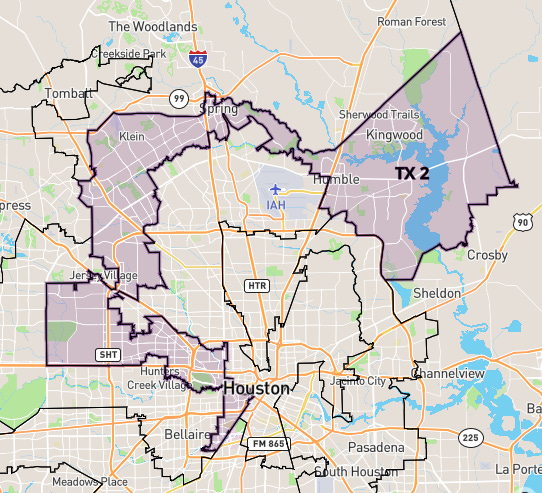
This image is of Texas’ legislative district 2, currently held by Dan Crenshaw (R).
In Canada, federal electoral districts (known as “ridings”) for Members of Parliament are altered with every decennial census, although one of the criteria in redistricting is to keep changes to the margins if possible, reflecting historical boundaries. The system works as follows:
For each of the ten provinces, the Chief Justice of the Province appoints a judge from that province to head the electoral boundaries commission. Two other members for the panel are chosen by the Speaker of the House of Commons in Ottawa. The process in non-partisan (yes, really).
The charge for each of the ten commissions is as follows:
Propose a new electoral map for their province by considering such criteria as average population numbers, communities of identity and interest, historical patterns of an electoral district, and geographic size of electoral districts
Consult with Canadians through public hearings
Submit a report on their considerations and propose an electoral map to the House of Commons
Consider objections from members of the House of Commons
Prepare a final report outlining the electoral boundaries for their province.
The fine print is here.
Here you can find from the official website the proposed 2022 changes to the ridings in the province of Saskatchewan (I lived and voted in Regina-Lewvan), with maps of the old and proposed new boundaries, and data on population changes (in general, the province, like all places on the prairie, is becoming gradually more urbanized). Here are the commissioners. Provincial governments (which in Saskatchewan right now is Conservative) do not have any say in the process, and in particular cannot try to influence the commission to work the boundaries in favor of their own party.
In all my time in Canada I cannot recall a single incident where there were allegations of improper procedure or biased outcomes.
And if you look at the maps and their proposed changes, you will not see a single riding that resembles in any way, shape or form Texas-2 (nor will you find them in Canada’s big cities).
I present this just as a thought: when something is obviously fubar, as is the US system for redistricting, instead of just having the two parties trying to figure out how to best flourish in these ruins of all common sense, it is worth remembering there are alternatives, and they aren’t even all that complicated. I know it is not going to happen. It’s still worth remembering.
*Canada and the US share the problems that arise with first-past-the-post elections for the lower house, I’ll leave that for another time…
What seems to be missing in the US is a strong social norm against gerrymandering. If it existed, those carrying it out in broad daylight would displease even their own supporters.
I don't think it's really possible for anything to be non-partisan in the United States. Maybe it's possible in Canada because it's a constitutional monarchy, but in the US there's nothing beyond the Democratic and Republican Parties, not even in theory.