
W is for Well-Being
Do the arts make people happy? Is this the right question?

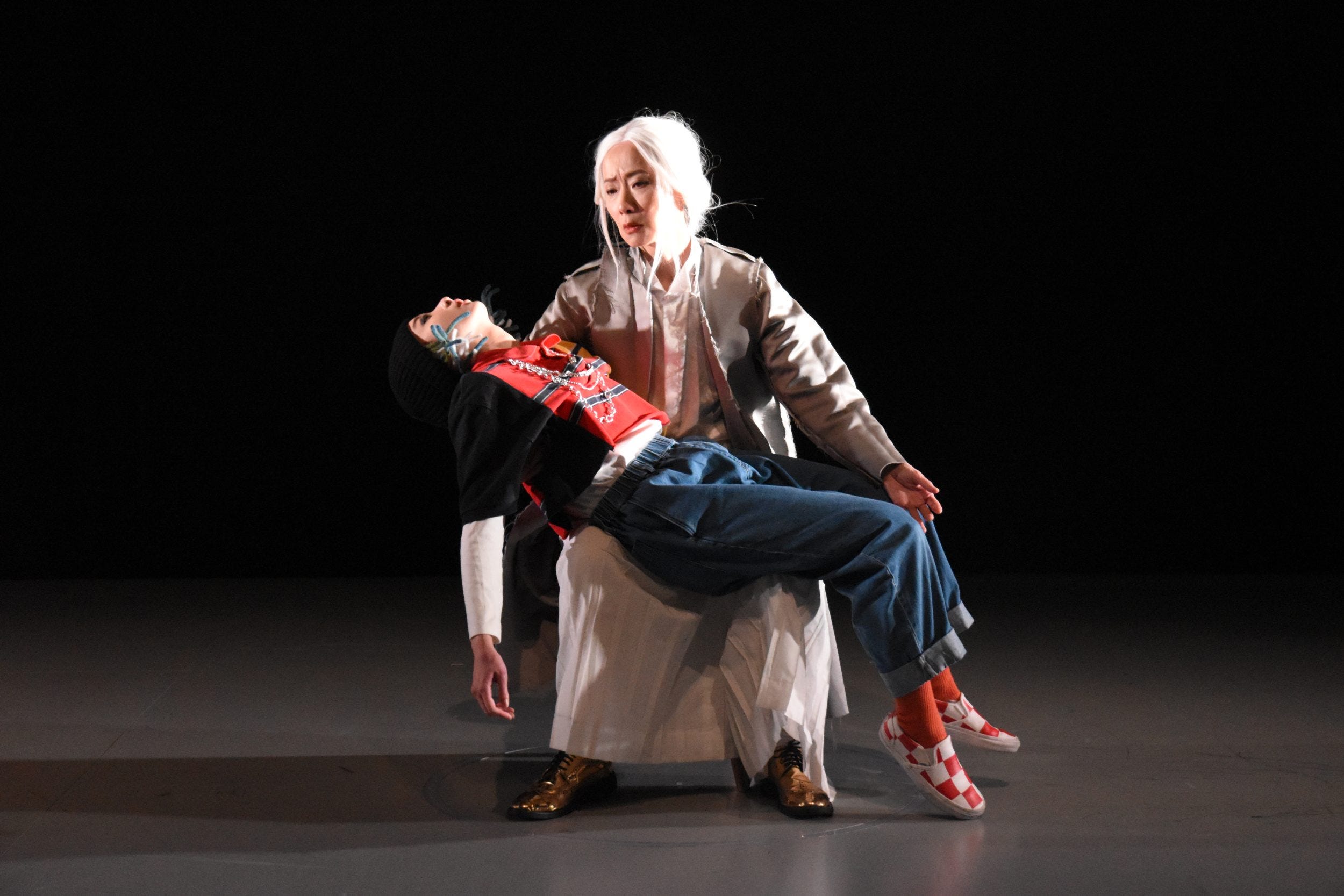
(‘King Lear’, produced by Tang Shu-wing Theatre Studio and directed by Tang Shu-wing, 2024).
The World Happiness Report is the gold standard in measuring how people are doing, and they ask three sorts of questions. One is life evaluation, which “asks respondents to evaluate their current life as a whole using the image of a ladder, with the best possible life for them as a 10 and worst possible as a 0.” It also asks questions about “positive emotions” - laughter, enjoyment, interest - and “negative emotions” - worry, sadness, anger - and whether they have been experiencing these. People are different, and two people could be in identical circumstances and yet give quite different answers regarding “life as a whole”. But with a large sample you can track movement over time between countries, age groups (I’ll return to this later in the series) and so on.
No policies are going to make everyone happy, but we can look to what sorts of policies bend the averages in a good direction. In an interview conducted by Peter Singer with one of the great scholars of the science of happiness, Richard Layard, the question of what we know about happiness comes up. Layard says:
If you take adults, you explain what they say about their life satisfaction by the other things that you know about them. And you look at how powerful the variation of those other things is in explaining the inequality in life satisfaction. Always first come health measures, especially mental health. We typically have separate measures of mental and physical health. Then come human relationships. Whether you have a family and stable family life, very important. Whether you have work, which is a kind of relationship, and whether you are in a satisfactory relationship at work with your colleagues, also very important.
… Then somewhat less important as an explanatory factor: how you feel about your community, do you feel safe, do you feel good in your community? And then comes income. I think it's really important that we recognize the importance of income, but we keep it in its place. So in these statistical analyses... income is explaining at most 2% out of the 20% of the variation in happiness that we can explain across the population."
… The extent to which people think wallets will be returned is in fact very closely correlated with whether they actually are returned. So we've got quite good measures of culture like that—the degree of trust in a country, the degree of trust that people in a country have in other people in the same country. And that's very important - one of a number of important variables that explain this inter-country variation.
So the arts don’t appear directly in these main factors; perhaps if we dig deeper…
Studies of the arts and happiness run into the same sorts of problems as asking whether the arts make us more empathetic: it is not really feasible to do controlled experiments except for the most trivial, immediate-effect style, and so we are left with correlations and no sense of cause-and-effect. Are people who are happier by nature drawn to the arts, or does being drawn to the arts make people happier, or is there no relationship at all?
Chris Hand, in the Journal of Cultural Economics (2018), found that when you include all the other things that might be expected to affect happiness - health, relationships, income and employment, and such - there were some effects of attending the arts on happiness, for those who are at the lower end of the happiness distribution (for those already pretty happy, attending the arts doesn’t have much effect). But, again, it is just hard to tell much when we don’t know who is drawn to the arts in the first place. Nor do we know much about which arts matter. Many people are drawn to easy entertainments, but these studies (and Hand cites many of them) resist, as they must, drawing critical distinctions.
Amartya Sen and Martha Nussbaum led the movement to think in terms of capabilities: what sorts of things are available to people to do if they so choose? What kinds of lives can they possibly lead? An expansion of capabilities, and efforts to help the poor by focusing on capabilities, was seen as a practical way to go about policy, since “happiness” can vary so much simply by people’s dispositions. Sen was deliberately vague as to what the important capabilities might be, but in Women and Economic Development (2000) Nussbaum tried to create a list that would be cross-cultural, universal. It included this on expression:
Being able to use the senses, to imagine, think, and reason – and to do these things in a “truly human” way informed and cultivated by an adequate education, including, but by no means limited to, literacy and basic mathematical and scientific training. Being able to use imagination and thought in connection with experiencing and producing self-expressive works and events of one’s own choice, religious, literary, musical, and so forth. Being able to use one’s mind in ways protected by guarantees of freedom of expression with respect to both political and artistic speech, and freedom of religious exercise. Being able to search for the ultimate meaning of life in one’s own way. Being able to have pleasurable experiences, and to avoid non-necessary pain.
I can’t disagree with any of that, though notice the focus is on freedom - admittedly not a trivial concern in many places in the world - a very important part of well-being, but not one that speaks directly to what we think the arts do for people.
Or is it? Let’s take Bob who lives in Ellettsville, a small town a few miles from Bloomington. Bob is not a false caricature; he is representative of a demographic we find in all studies of arts engagement. Bob likes fishing and deer hunting, doing construction and upgrade work on his house and yard, he sometimes watches sports on tv, or comedy or action shows, his radio is tuned to Today’s Best Country, or Talk Radio. He doesn’t read books, he doesn’t go out to shows. He’s just not that interested. There are all sorts of arts engagement possibilities for him. Ellettsville has a very fine public library (I have used it myself). Our public radio station, which reaches his home, has excellent classical music (and, for those who are interested, jazz) programming, and the University has more free, live music recitals than even the most dedicated listener could absorb. The art museum at the university is extensive, and has free admission (admittedly, parking on campus is a drag). There are music festivals and live theatre in Bloomington, twenty minutes away (which is not far given he will often drive at least that far to do other things he likes), and it’s all pretty low cost. He just isn’t into any of that. And he is happy, he would report a high level of well-being should anyone contact him for a survey. I’ve always objected to people who look at surveys of arts participation, and ask of the people not participating in the arts, “what are the barriers?” Maybe there isn’t any “barrier”, they just aren’t interested.
So it doesn’t really make much sense then to ask whether arts activities, the kinds listed in academic studies, would make Bob happier. It’s just not his thing. I would feel deprived if asked to live Bob’s life, it would make me unhappy. But nobody is asking me to do that: we each have the capability to live the kinds of life we wish to lead.
And so … in terms of the standard ways we measure life satisfaction, we don’t know much about the arts. There might be some benefits, but in papers like Hand’s they are tied to going out - seeing a movie in a cinema is arts attendance, but not watching it at home (a study by Bruno Frey found a negative correlation between watching television and reported happiness, but that tracks); reading a book is not arts attendance. Going out helps physical health and mental health more generally. Going out to a carnival might do good things for your happiness, but so does walking your dog, or going fishing, or helping a friend build a new deck for her house.
But what about the art itself, especially when the art itself is cathartic but by no means cheering. What does it mean for measured well-being or happiness to go to a production of King Lear, aside from all the things that go along with having a night at the theatre? I choose to read Jude the Obscure, and this is a rational decision on my part, it must be something that I want to do, that I think at that moment is better than alternative things I could be doing. I’m certainly better off, as per Nussbaum, in having the freedom to do so. But am I happier for it, happier than Bob? I am just not sure that we can sensibly ask this question.
Or that it is the right question at all. From a utilitarian standpoint, adding up happiness across the population, it doesn’t make any difference what people do if it makes them happy, so long as they don’t harm others. Bob and I can be equally content in the way we live our lives. Jeremy Bentham was right, if happiness is the metric, then pushpin is as good as poetry, so long as the happiness somebody gets from one is equal to the happiness someone else gets from the other.
But to survive, art needs people who desire it, who get their satisfaction from serious music, live theatre, dance and painting and sculpture. I don’t begrudge or look down on Bob, the world is a better place for having people with all kinds of interests and talents. But a society where everyone is “Bob” would be happy in some ways, though eventually impoverished in ways they will not recognize.
Not only will Bob drive 20 minutes to something he likes that's not a music festival, Bob will wake at 3 AM to get in position in the woods by 4:30. Hunters are amazing.
You've been making an interesting serial argument that there's an aspect of busybody-ness to arts policymaking and the accompanying rationalization. It strikes me as self-evident that art wouldn't need advocacy if it were truly a bountiful source of economic benefit and broad eudemonia, which it is not, but which is often claimed. It is a niche activity for the sensitive. Policy regarding it largely shouldn't exist.
I want to push back a bit on your conclusion. If everyone was Bob, there may be fewer deer, but can you claim that Bob World is impoverished? From what standpoint? Are you impoverished for never having taken down an 8-point buck? This too strikes me as an intrusion of values.