
Together forever


In the New York Times this weekend, Kurt Andersen has an op-ed on how the United States has become so deeply polarized that it just might be inevitable that the country splits in two (gift link here):
A national divorce — let alone a civil war — is, for now, the stuff of fiction. But while loose talk from rabble-rousers has distracted us, the nation has sunk, almost unnoticed, into an unspectacular yet profoundly strange new arrangement. It’s not yet a divorce; it’s more like a bitter, loveless marriage in which the parties stay technically but less and less enthusiastically united because splitting up is too complicated or dreadful or expensive. …
We can’t keep going this way. Escaping federal dysfunction and avoiding real hostilities over the long term will require some kind of radical shift. Perhaps states and regions could become much more independent. Like the regional autonomous communities in Spain, some of which collect nearly all the taxes their inhabitants pay and then forward a negotiated share to the national government. Or Switzerland, where cantons can divide or reconfigure and each one decides whether newcomers become Swiss citizens.
Even that might not be enough. Someday down the line we may decide we have no choice but to call it quits. If so, I hope we could follow the lead of post-Soviet Czechoslovakia, whose 1993 breakup into two nations was so calm, it was called the Velvet Divorce, a kind of conscious national uncoupling. For our huge, heterogeneous country, it would be extremely difficult and painful. But in the long run, it might still be better for the kids.
But … Czechoslovakia - the key is in the name. There were two “nations”, each with its own language, and a line could be drawn separating the two. It wasn’t perfect or easy, but at least feasible. But the US is not like that - people who live here are Americans, and Andersen doesn’t really give any details on how a split would actually work. Spain and Switzerland (!) are not models we can import.
To illustrate, I go to VoteHub and its map of the 2024 Presidential vote by precinct, with red and blue representing Trump and Harris, with stronger tones indicating a stronger majority. Here are four cities, but I could have picked many more:
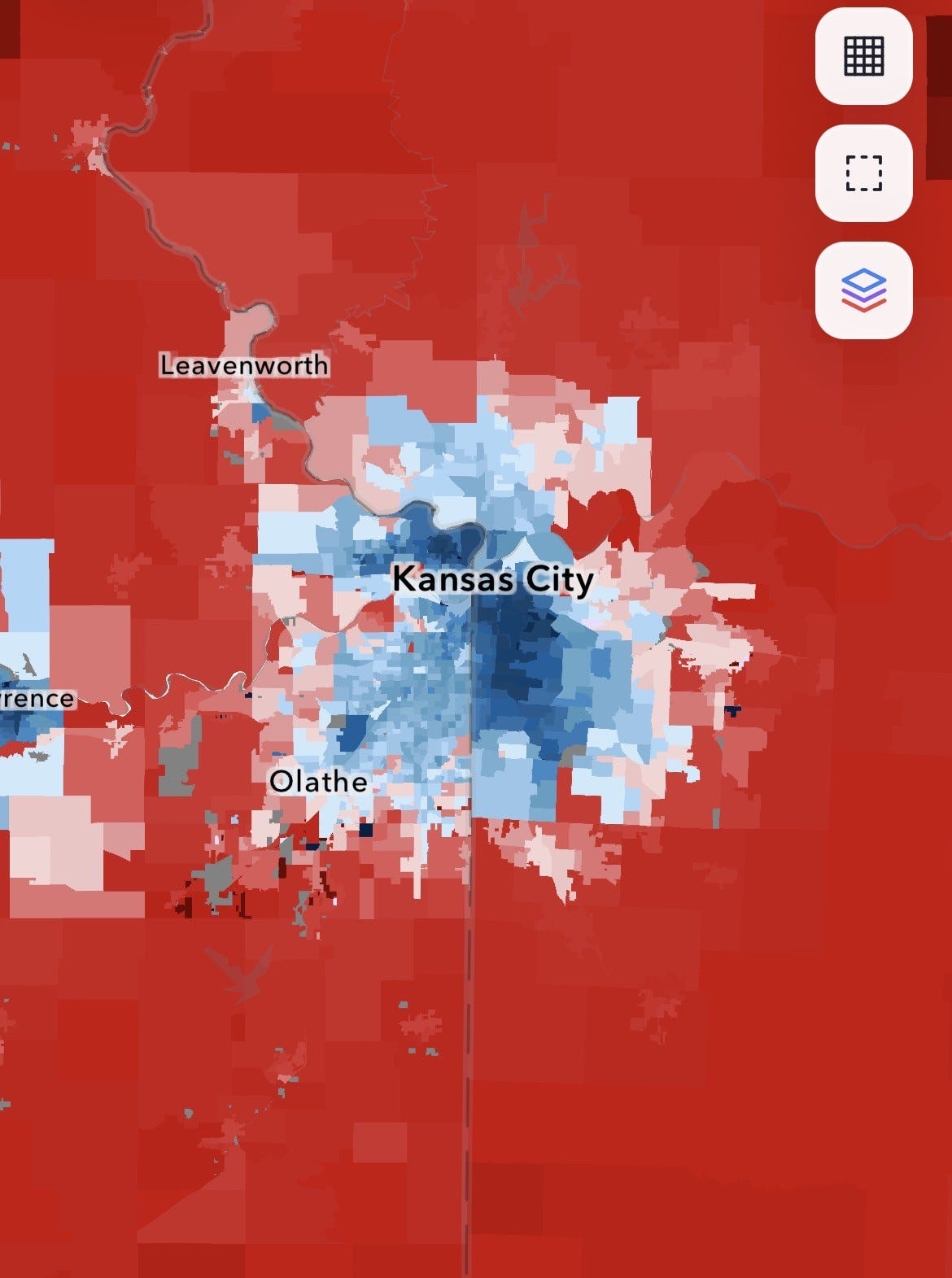
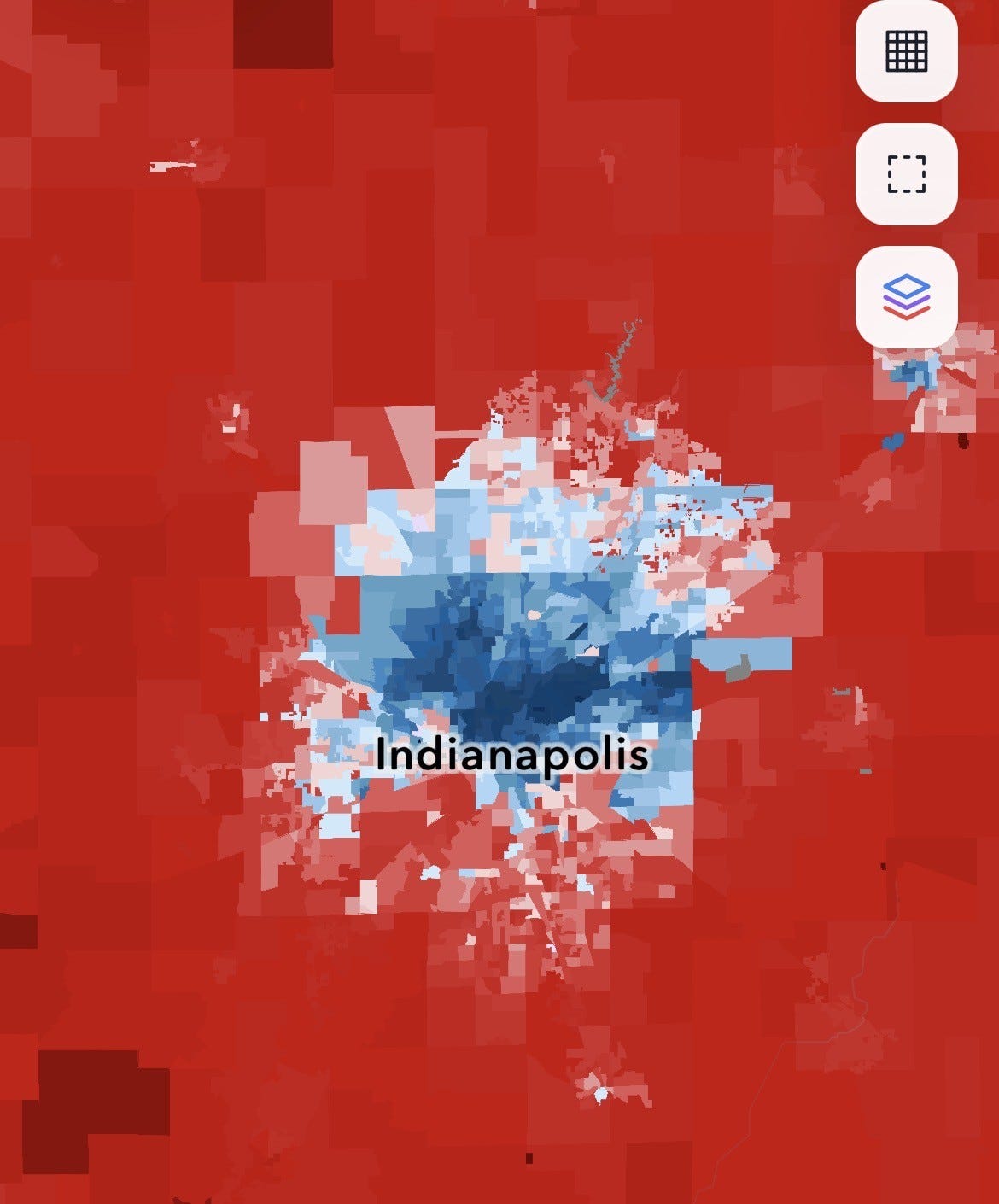
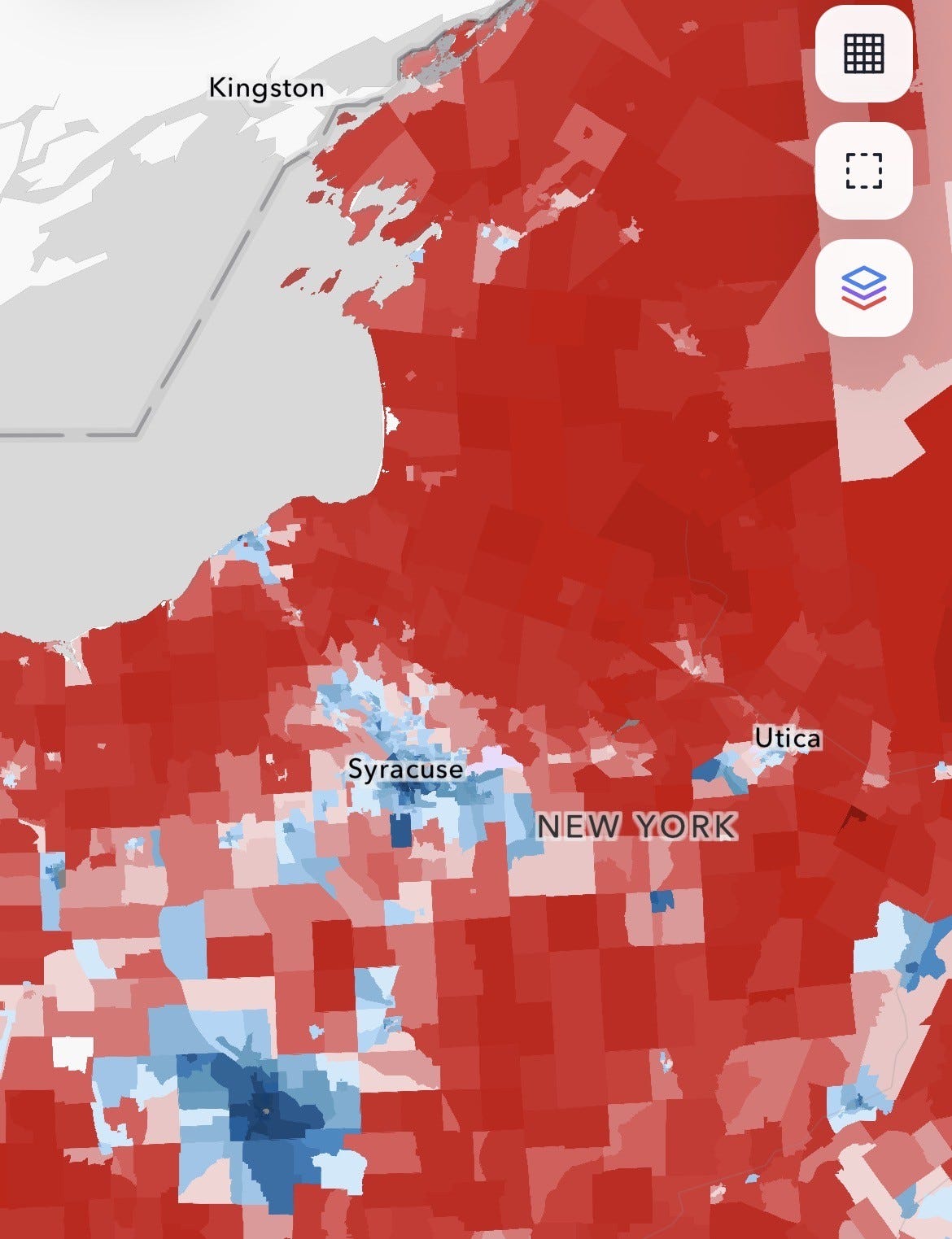
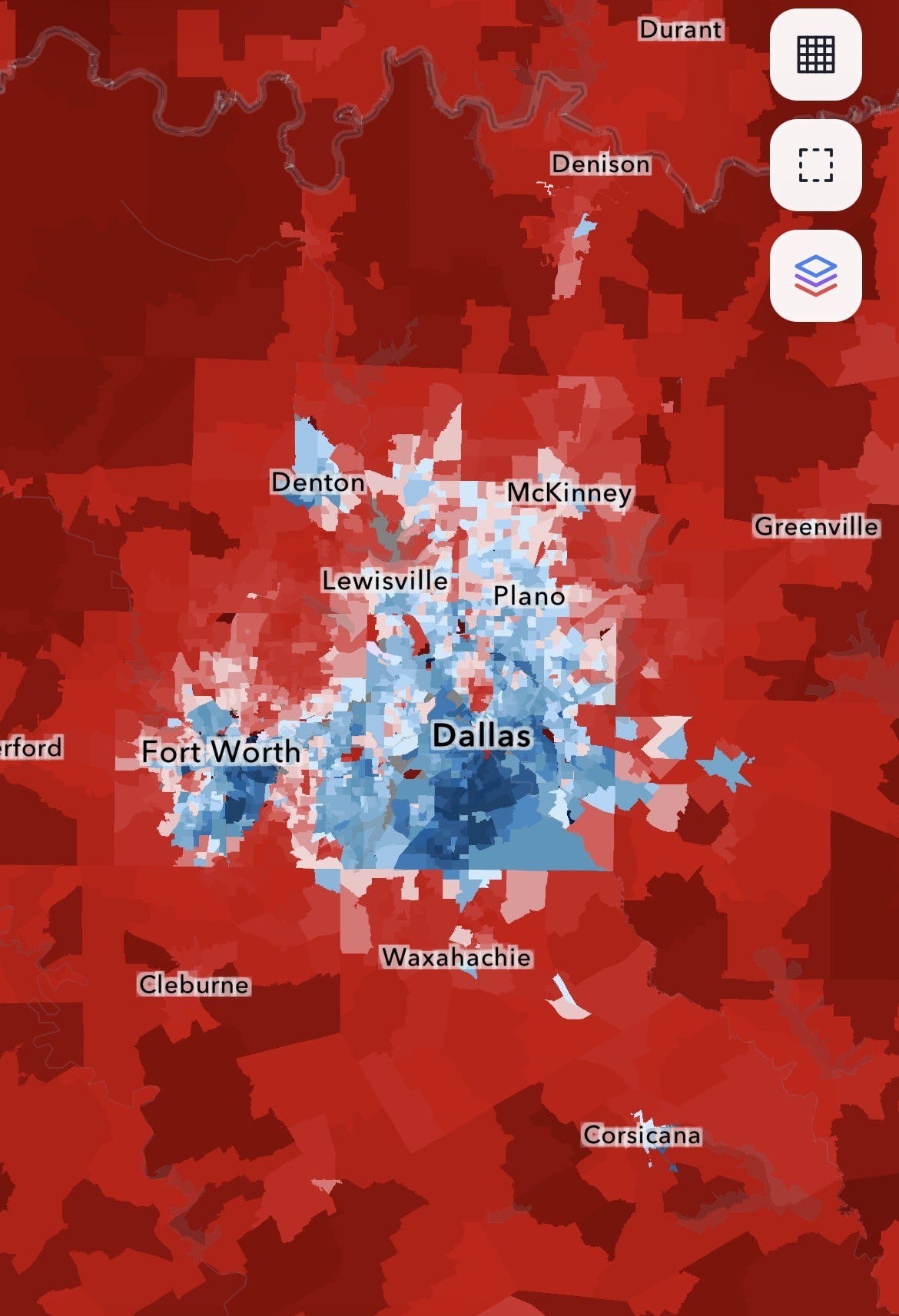
Cities vote mostly blue, Suburbs are a mix, and Rural vote mostly red (I once read a piece from someone on the right saying that red states ought to split, and make Dallas their capital. Had they seen the above map?). This is true in blue states (states that tend to have at least one really big city) and red states (less concentrated). Southern Illinois looks and feels a lot like southern Indiana, but Illinois is a blue state because Chicago, and Indiana is a red state because Indianapolis is not nearly so big as that. But the patterns are identical. Further, often states are “blue” or “red” by very small margins - that’s why they are called swing states. How are they to be allotted in a divorced America?
Every country has conservatives and liberals, and they have to find a way to work out how to collect taxes, provide public goods, and make laws and regulations. That’s what politics is. The US is not special in that sense - In the UK the conservatives of Norfolk are in the same boat as the Labour voters of East Ham. And you can’t solve the political problem by saying Indiana will be in one country and Illinois in another. You debate issues, have political campaigns and elections, horse trading in the legislature, and, for better or worse, run a government that has to serve people of all political stripes.
Andersen begins his essay by quoting various right-wing kooks on whether there will be another civil war, another serious attempt at secession, but, well, these people are daft - it is not a serious idea, it is a waste of our attention. We’re stuck with each other. Inside every state, every metropolitan region, people with very different political views live walking distance from each other. I live in a rather “blue” neighborhood (though not exclusively so) but I could ride my bike to a “red” one (though not exclusively so) in just a few minutes. Politics with people with different views than your own might be frustrating as hell sometimes, but there’s no getting away from it.
Agreed. On the other hand, "no choice but to live together" does not imply "a feasible way to get along". Northern Ireland as an example.
I continue to be of the opinion that our current "polarization" is something specific to the Trump Era, which really flooded the Biden Era. Maggie Haberman said recently on Ezra Klein's podcast something I heard often before, but today it clicked: "There is no Trumpism, only Trump." Which also means: "Without Trump, there is no Trumpism." This is a fever like the McCarthy Era, and eventually a fever breaks. At that point, we all may return to our regular lives.