
R is for Rural
What can arts policy do for rural places?

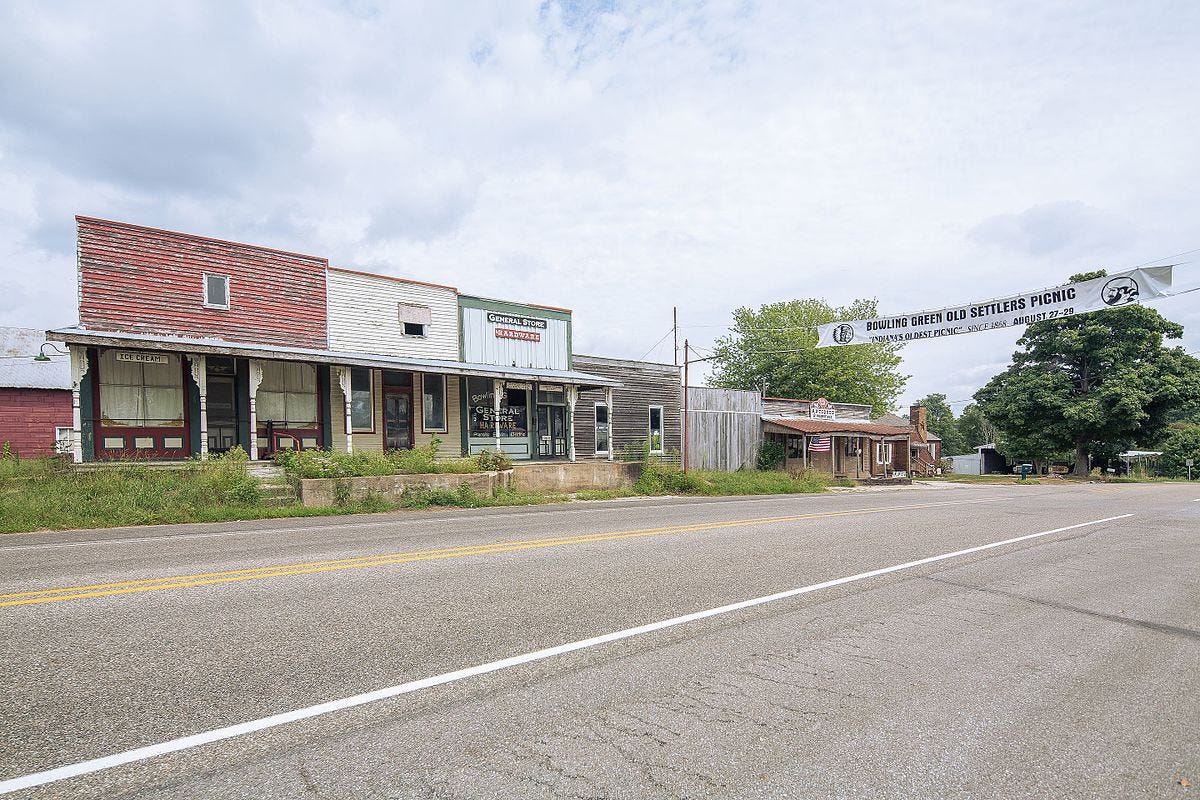
This is Bowling Green, Indiana. I’ve driven through many times, when I would go to watch my kids run cross country races in Terre Haute. It’s on one of those nice, scenic rural two-lane highways that don’t have the stress of the Interstate. It is a Census Designated Place, according to Wikipedia, but not big enough to be a town. Its population peaked in 1870. The Pioneer Cafe, which has really good reviews online, is closed - it says “temporarily”, and I hope it re-opens some time.
Depending on whom you ask, between sixteen and twenty percent of Americans live in a rural place, distant from any urban centre. That number used to be bigger, but people moved to cities and suburbs for job opportunities, since the proportion of people who work in agriculture or resource extraction has steadily and drastically declined since the 1800s. And some areas that used to be rural simply got absorbed by expanding metropolises: my van once broke down on Five Forks Trickum Road in Georgia, and I pulled in to a repair shop. The guy told me that when he first started up, it was a dirt road, going past farms. But Gwinnett County now has a population just south of one million. When you read stats on low economic growth in rural counties, you have to keep in mind that there have been rural places with really high economic growth - it’s just that they ceased to be “rural,” and don’t get counted that way anymore.
There are places like Bowling Green, Indiana that are not going to become part of any bigger city. This is it, and people who live there will shop by going to the Walmart in Spencer, a twenty-minute drive away.
Urban centres are desirable because firms find they are more productive when close to a big and diverse pool of labor, and to other firms with whom they can contract, and observe and pick up ideas. And people are drawn to cities because job prospects are better (which tends to outweigh the higher cost of living space), and also because, as Ed Glaeser makes a point of saying, cities are great places for consumption: there is more to do, and a wider range of things to do. Any arts presenter needs at least a critical mass of consumers to make it financially viable, and in a big city there is more chance of getting that critical mass, especially if what you do is quite niche. It’s not going to happen in Bowling Green - if it ever did, cost disease will have now taken its toll.
Mama used to roll her hair
Back before the central air
We'd sit outside and watch the stars at night
She'd tell me to make a wish
I'd wish we both could fly
Don't think she's seen the sky
Since we got the satellite dish…
James McMurtry, Levelland.
Should something have been done to protect small town, rural culture? I’m not sure what, though I’ve pondered this a lot over the years. There’s a line in G.A. Cohen’s “Rescuing Conservatism” on how big-C conservatives would “blather on (as Prime Minister John Major did) about warm beer and sturdy spinsters cycling to church and then they hand Wal-Mart the keys to the kingdom,” and round here there are an awful lot of mostly-boarded up towns and the great big stores on the outskirts, and if there are people who think that America was great when small towns had real main streets where everybody shopped and stopped to say hi to their friends and neighbours, and that we need to, so to speak, make America great again, then some hard decisions about zoning will need to be made, and even then the population declines will continue.
My parents grew up in neighbouring very small towns in Scotland, though big enough that my dad could get piano lessons, and he became very good, winning Chopin competitions as a teenager. My parents met at the dances, which they tell me were on all the time, with live bands, and everybody went - it was what you did. They still played these records at parties after moving to Canada:
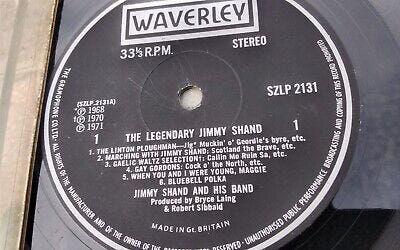
Back then, ordinary culture meant getting together in person, with live music, many times a month. I know there are pockets where this exists, but it now seems a rare thing.
For any kind of social life, people have to know each other, and get together regularly. Robert Putnam wrote about the decline in social capital in the US, that people these days go bowling alone or with just one or two people rather than joining leagues. Living on the Canadian prairie, I was struck by the fact that even really small towns all had a curling rink, with active leagues, and the rink would become the place everyone would gather (and, as Putnam might have observed, it was a place without class distinctions). “Curling together”: sociology students, I offer to the public domain this thesis topic.
“Folk art” began its decline with the industrial revolution - one hundred years ago Ralph Vaughan Williams was having to rush around England to make notes on folk songs before they were lost altogether. When Thomas Hardy made a point of incorporating songs into his Wessex novels it’s clear he thought the end was in sight.
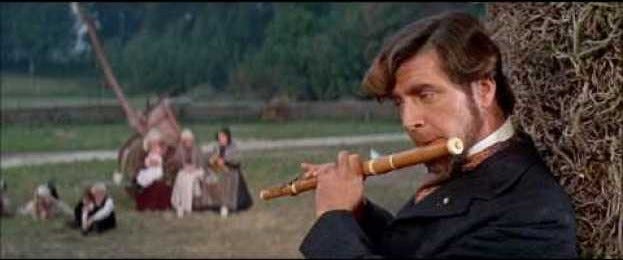
And so now “folk music” is something for the NPR crowd, and it is not going to be revived elsewhere - it is detached.
The NEA has had a program on “rural design”, although it is hard to know how more than a handful of rural places can really turn this into significant “economic development” (the handful of successes get a lot more press than the many places that really cannot make a go of this).
The USDA defines “rural placemaking” as:
Placemaking is a collaborative engagement process that helps leaders from rural communities create quality places where people will want to live, work, visit and learn. By bringing together partners from public, private, philanthropic, community, and technology sectors, placemaking is a wrap-around approach to community and economic development that incorporates creativity, infrastructure initiatives, and vibrant public spaces.
Everything in that description is a good thing (although I am really averse to “vibrant” … I’ll come back to that). But I have always worried that it gets hopes awfully high. Rural population is not going to grow, and so you are looking at trying to build public goods and infrastructure with a declining population base, and as any city with declining population can tell you, that is really difficult and expensive, including such basic things as keeping your water system up to date, much less high-speed internet.
Can the arts play a part? Of course it is great to have concerts and plays and galleries. But nobody can make a living at that unless they are playing to a significant audience. So, tourist towns with lots of galleries, and maybe a nationally-known music or Shakespeare or film festival can possibly make a go of it, but these will be subject to the “superstar” phenomenon in the arts (next post), and many towns might invest an awful lot into culture that isn’t really for their own residents, and find very meager returns.
The town was intentionally bent upon being attractive by exhibiting to an influx of visitors the local talent for dramatic recitation, and provincial towns trying to be lively are the dullest of dull things.
Provincial towns are like little children in this respect, that they interest most when they are enacting native peculiarities unconscious of beholders. Discovering themselves to be watched they attempt to be entertaining by putting on an antic, and produce disagreeable caricatures which spoil them.
Thomas Hardy, Desperate Remedies (1871).1
People who live in rural areas want to be there. They know there will not be the cultural amenities of a big city, or even of a small city, but have thought, all things considered, it is a trade they are willing to make, for a bigger house and yard, quiet, a slower pace. They can be constricting - the Indiana singer who claimed that you can “be yourself” in a small town forgot to say that this only applies to particular sorts of “yourself.” But there are real positives.
But you can’t force some sort of culture - high or “folk” or tourist-trap - on places. You can make what is feasible available - I am full of praise for the humble bookmobile, and for pragmatic preservation of old structures. Most importantly, make sure public schools, even the small rural ones, have art and music teachers to give every student a taste of the possibilities; I didn’t go to a high school school with all the fanciest gear, but I did have a music teacher who changed my life.
This was Hardy’s first novel, not that well-known, and I am here to tell you: it is bonkers, and if you are new to him you might want to look at some of his more mature works instead.
A bit of pushback on Bowling Alone. Running clubs (and swimming, cycling and triathlon) are booming. I just moved to a new city where I knew no-one and got an instant social life by joining a couple of clubs (for single folk, they are, apparently "the new dating app"). But unlike team sports in organised leagues, there's no expectation that I will turn up on any given day.
This actually was my area of research before I retired: I was the head (and sole member) of the Center for Rural Arts Development and Leadership Education. I studied Appalshop, and Double Edge, and Robert Gard, and many others. And what I ended up concluding was that you couldn't just transplant the values and business models of urban arts institutions into rural areas; i.e., "Honey, I Shrunk the Guthrie" was not an option. To make it work, you had to think differently about virtuosity, professionalism, shrinking the aesthetic distance between artist and spectator, and so forth. I.e., all the things that are frowned on in school. It's a heavy lift, and requires a whole lot of unlearning.