
Getting universities wrong, a continuing series
Tell us more

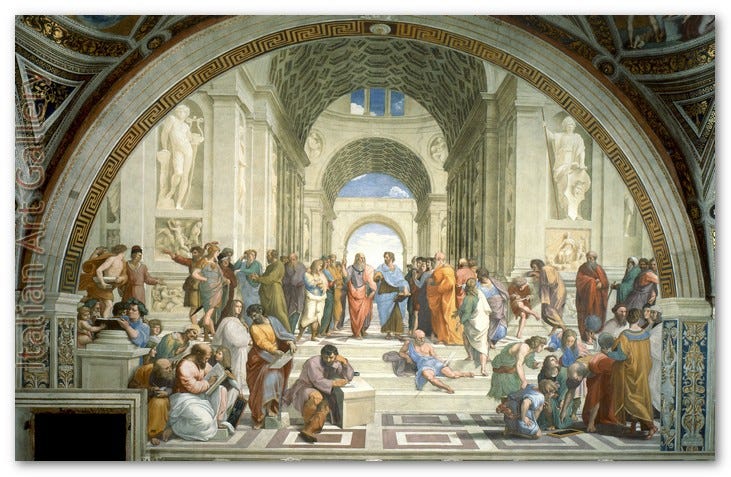
I had a wonderful trip to Turkey and Greece, I am really grateful to have had the opportunity to visit, and everywhere to meet such delightful people. I am resolved to learn more about ancient art and tragedy and history, and to try some new recipes.
I’m sorry my first post since coming back has to be so snarky…
In today’s Washington Post, Robert George and Cornel West weigh in on what’s wrong with American universities, and how to fix them - gift link here. It’s the sort of piece that frustrates me to no end, not just because it is such a misdiagnosis, but that it is a harmful misdiagnosis, leading to bad policies.
In a nutshell - they say our campuses lack intellectual diversity because certain ideas are forbidden to be expressed.
When, for example, high percentages of faculty and students report that they regularly engage in self-censorship, or less than 3 percent of faculty on a campus say they hold conservative views, there are entrenched problems that demand the university leadership’s attention and redress. They require concrete efforts to increase viewpoint diversity, such as by ending discrimination on the basis of ideological commitments (whether explicit or unspoken) in admissions and hiring and doing better to reach out to those with underrepresented viewpoints and perspectives. They call for the principled defense of freedom of speech and the consistent enforcement of rules against speech-chilling behaviors such as harassment and the shouting-down of speakers, as well as any activities that disrupt core academic priorities such as teaching, studying, and research. And they demand a commitment by university leaders to ensuring that seminar rooms and lecture halls are not “safe spaces,” but rather Socratic Spaces, where students are made to wrestle with ideas that challenge their preconceived assumptions and deeply-held beliefs — indeed, ideas which may make them feel uncomfortable.
First of all, the vast majority of university classes are not ones which lend themselves to being Socratic Spaces. I’ve taught Microeconomic Theory, and if you want to get anywhere before the semester comes to an end, you’ll probably find that chalk-and-talk lectures are best suited to the purpose of getting students to understand the constant-elasticity-of-substitution production function. Courses in Organic Chemistry, Geographical Information Systems, Municipal Finance, the History of the Tang Dynasty, and Programming in Unix, are not there to challenge our students’ preconceived assumptions. Nor does a call for “viewpoint diversity” make any sense in these contexts. So the first problem here is that while George and West might like to get all Socratic with the their students, most university classes do not, and practically cannot, do this. Our Indiana state governor recently said that he wants public universities to focus on what degrees will best serve the job market (even though recent forecasts of what those degrees are have proven to be catastrophically wrong), which means even less chance for any sort of course that might be “Socratic”.
My second problem is one that characterizes virtually every commentary I read on how there are opinions being suppressed on campus: what are those opinions, exactly? They fail to name a single one. They do give some examples of Big Questions -
Does God exist? What constitutes living a good life? How should the Constitution be interpreted? How should policymakers go about addressing particular social concerns over which there is deep division in their communities?
but this is a bit scattered. In my experience students have been able to have different interpretations of Aquinas and Aristotle, and differing beliefs regarding the existence of God or of the pursuit of human perfection, without everything falling to pieces.
But they give the game away a bit with this obvious self-censorship on their own part:
A university genuinely committed to the disinterested pursuit of truth would never permit external actors — from protesters and activists to donors and government agents — to influence how it treats holders of widely criticized views, whether those views are popularly mocked as supposedly “unenlightened” or slandered as “bigoted.”
Tell us more! What views are slandered as “bigoted”? Name one. I’ll help by giving a concrete example: suppose a student in a class claims that it is a scientific fact that black people are, because of genetic factors, on average intellectually inferior to white people. Is it slander to call that bigoted? Should the professor engage with this student in a debate over the “science”? Or is it in the best interests of the educational mission of the university to flatly tell the student he is wrong and his suggestion is out of line? Should the campus welcome visiting speakers who want to promote that view? Another student claims that Jews control, for their own benefit, the system of international finance. Do we give over a 75-minute class period to the topic? But George and West don’t want to deal with these messy practical details.
George and West are not alone in this particular evasion - I’ve read hundreds of pieces that pull exactly the same stunt. But if you want to claim that what colleges really need is complete openness to all views, you need to get into the details.
How are fatuous articles like this harmful? Because they lead to bad public policy. In my state of Indiana, the legislature has passed a bill requiring “intellectual diversity” in all teaching, and for all faculty, tenured or not, to be regularly evaluated on whether they are fulfilling the requirement, and with students able to snitch on profs they don’t like by claiming lack of intellectual diversity, without any idea of how this is supposed to be implemented, or what the professor teaching Econometrics or Entomology is supposed to do, exactly. And the bill is proposed because someone says “faculty are all Democrats, universities must be factories of wokeness”.
Debate over the role of universities and how they ought to be governed has been terribly distorted by the incorrect notion that their purpose is to be a place of “uncomfortable” debate over the political divides of the moment as defined by cultural debates that are as far removed as possible from any sort of intellectual content. And the Republican party has decided to flex its current political power by dictating terms of governance and policies on campuses about which they have little understanding, and could not be bothered to understand, in the name of solving the intellectual diversity “problem”. Articles like this one by George and West don’t help in the least.
I agree with a lot of this, especially the part about George and West needing to confront the thorny specifics of those more extreme potential cases directly. That said, in practice it seems like there's a lot of middle ground where it's not nearly as blatant.
While I also agree that "viewpoint diversity" doesn't quite make sense for a lot of classes, I have seen plenty of attempts to force certain views and conclusions in many of those same kinds of courses. One might have a GIS course themed around "environmental racism" or an economics course required to discuss "systematic disparities between marginalized groups."
The "solutions" being imposed from above, especially the ham-fisted way the Indiana law is constructed that doubles-down on centralized censorship, aren't helping and are generally exacerbating the problems of politicization. But I don't think these concerns came out of nowhere and it would behoove academia to have a better response.
They should have provided specific examples of invidious accusations and process-is-punishment investigations. I certainly can. Look at what happened to Bret Weinstein at Evergreen, Carole Hooven at Harvard, or Alex Shieh at Brown, or just go down the list of cases at FIRE.
https://www.thefire.org/cases
That said, one detail they did cite is the 3% of faculty holding conservative views, and you didn't address it. What is the Michael Rushton plan for reforming that fraction toward something resembling the American populace, which is larger by a factor of ten?