
Campus Art
Cover-up

A rambling post today…
In class we have been discussing the United States’ Visual Artists Rights Act of 1990, which is a limited version of what are known elsewhere as the “moral rights” of artists (which usually apply to all artists, not just visual artists) - rights that a creator retains in an artwork even after the work has been sold and/or the copyright transferred. VARA holds that the artist retains the right to be identified as its creator (and to not be identified as the creator of a work she did not make), and, subject to practical limitations, the creator
shall have the right—
(A)
to prevent any intentional distortion, mutilation, or other modification of that work which would be prejudicial to his or her honor or reputation, and any intentional distortion, mutilation, or modification of that work is a violation of that right, and
(B)
to prevent any destruction of a work of recognized stature, and any intentional or grossly negligent destruction of that work is a violation of that right.
Lighting and placement of a work is explicitly held not to be distortion, mutilation, or modification.
What happens when a work is on a college campus, and some students or staff object to it, finding it offensive? VARA only came into effect in 1990. In a case that arose a few years before that, Piarowski v. Illinois Community College, the art department decided to hold a faculty exhibition in a fairly busy part of the campus, and the art by the chair of the department, Piarowski, was (by written description - I’ve not seen the work itself) racially offensive. The college administration suggested moving the art to a less prominent location, and when he refused the administration simply removed the work. With no VARA in play, Piarowski sued that this action violated his First Amendment rights. Judge Richard Posner, in his inimitable style, ruled that no, it did not.
This year we have a sort of similar case, though this time the artist sued on the basis of VARA. Samuel Kerson was invited by Vermont Law School to paint two very large murals onto the school’s building walls. One panel depicted the origins of the slave trade, and the second the abolition movement, the underground railroad, and emancipation. There were protests and petitions, focused on that first panel, and what many viewers considered an offensive, cartoonish portrayal of Africans. The VLS did not try to remove or destroy the murals, but moved to cover them with acoustic panels, leaving something of a gap between the panels and the wall such that the work would not be harmed (Kerson argued that over time the panels might cause moisture to be trapped, ultimately leading to deterioration of the art, but VARA does not insist that owners put great effort into conservation, only that they do not engage in gross negligence, and no court saw this as gross negligence).
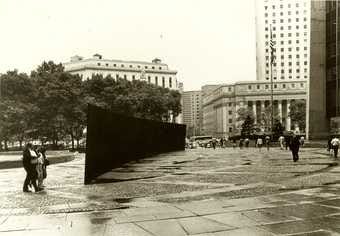
Kerson also tried to claim that this cover-up was detrimental to his reputation (which is a concern of VARA) since it would send a signal to the artworld that he is racist, which he claims adamantly he is not. But he lost his case in the district court, and then, last month, in the court of appeals. The Visual Artists Rights Act does not compel the owner of a work to show it, and I find that difficult to argue with (and in that respect this case might remind you of Richard Serra’s Tilted Arc).
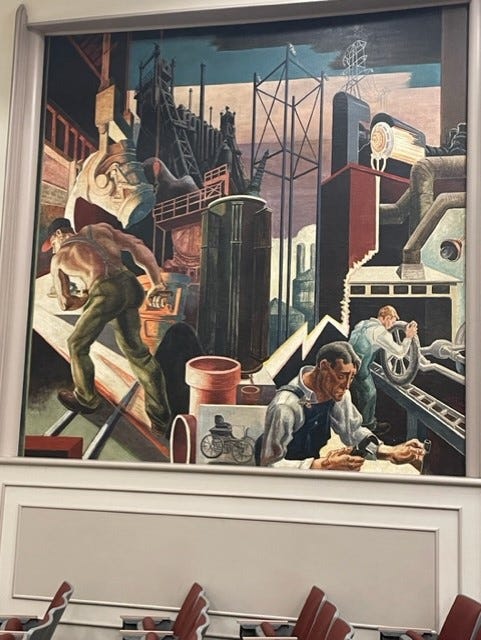
But it also reminded me of a case close to home - the Thomas Hart Benton murals here at Indiana University. They present a history of the state, and were commissioned for the 1933 Chicago World’s Fair. They are in a few places on campus - most people see them when they go to an event at the IU Auditorium. But there were two murals placed in a classroom. One of those, showing steel and automobile manufacturing, is shown at the top of this post. Here is the other:
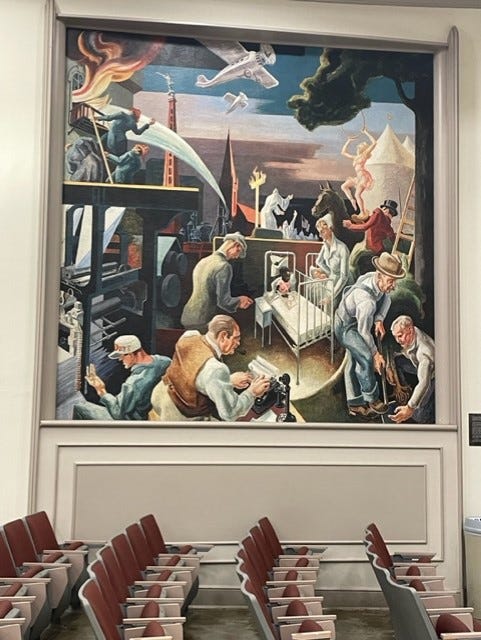
We see, in addition to a circus (!), aspects of progress - planting trees and the creation of a system of state parks, the founding of a children’s hospital, and modern techniques for fighting fires. In the foreground is the press, and Benton wanted to highlight its role in reporting, and uncovering, evil, including, as you in the background, the Klan, who in the early twentieth-century were for a time a powerful force in the state (if you look closely, you see the hooded figures waving not the Confederate flag, but the stars and stripes).
The problem in this case was not bad art or racist art, but with the placement of this mural in a classroom - students or faculty sent there to have their lectures in Finite Math or whatever had this striking and disturbing image to contend with. I spoke with a student who had had a class in that room, and she said it was not pleasant.
Students began to complain, and I thought the Provost at the time, Lauren Robel, handled it well. She recognized that these murals were of great historical importance, could not easily be moved, and indeed ought not to be moved. The problem wasn’t the panel as such, it was that classes were being scheduled there. There are classes in Woodburn 100 no longer, though anybody who wants to go and have a look at them can do so (I did this week).
(Sidebar: my fellow economists might recognize an analysis similar to that found in R.H. Coase’s famous “Coase theorem” essay, “The Problem of Social Cost”: the “cause” of an externality is not necessarily one party, but the unfortunate fact that two parties have been placed next to each other. I used to live directly across an alley from a really big railway shunting yard, and if you have never experienced that, I can attest that it is a noisy business, no-warning big bangs from cars bashing into one another to get hitched together. The noise externality was not caused by the trains, it was caused by having residential housing right next to the trains. If two grain cars bash on the tracks and nobody hears it, it’s not an issue).
There are posters outside of the (former) classroom to give viewers the historical context. It reads, in its conclusion:
Removed from its original context, the “Klan” panel has sometimes been misunderstood as a glorification of the KKK. Benton recognized the emotionally charged symbols - such as hooded Klansmen and a burning cross - could elicit a variety of reactions. He felt, however, that a truly effective artwork remains relevant through the comments and criticisms of viewers. By stimulating a dialogue about race relations in Indiana’s past, the mural continues to provide a touchstone for diversity awareness in our own time.
That last sentence reveals, again, how the word “diversity” has, by people with the very best of intentions, come to muddle clear speaking and thinking about race and justice on campus, but that’s a topic for another day.
You would think that anyone who read an explanation of the mural's composition, like the one that you linked to above ("Thomas Hart Benton murals"), could only complain about its presence in the classroom because it would be too tempting to look at it, to the detriment of one's grades in Finite Mathematics or whatever. At least the room is now being put to a use that may allow even more people to see it (school visits, lectures, performances, scholars, visitors, special class sessions, and other events).