
AI: Are we learning good?
It is to laugh

Prelude, from The Onion:
https://theonion.com/pragues-franz-kafka-international-named-worlds-most-ali-1819594798/
Now then. A few days ago, my son googled “Franz Kafka Airport” and here is what Google AI came up with:
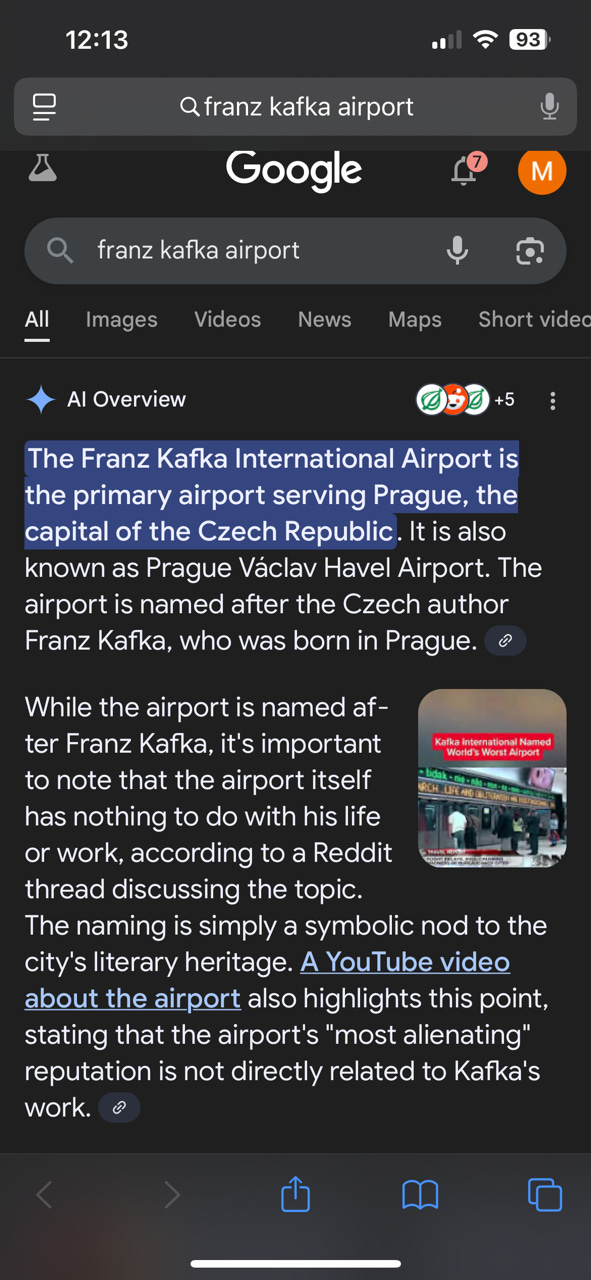
Being a public spirited sort, son informed Google that they might want to tweak this a wee bit. And so I had to check this afternoon for an update, and I get something new:
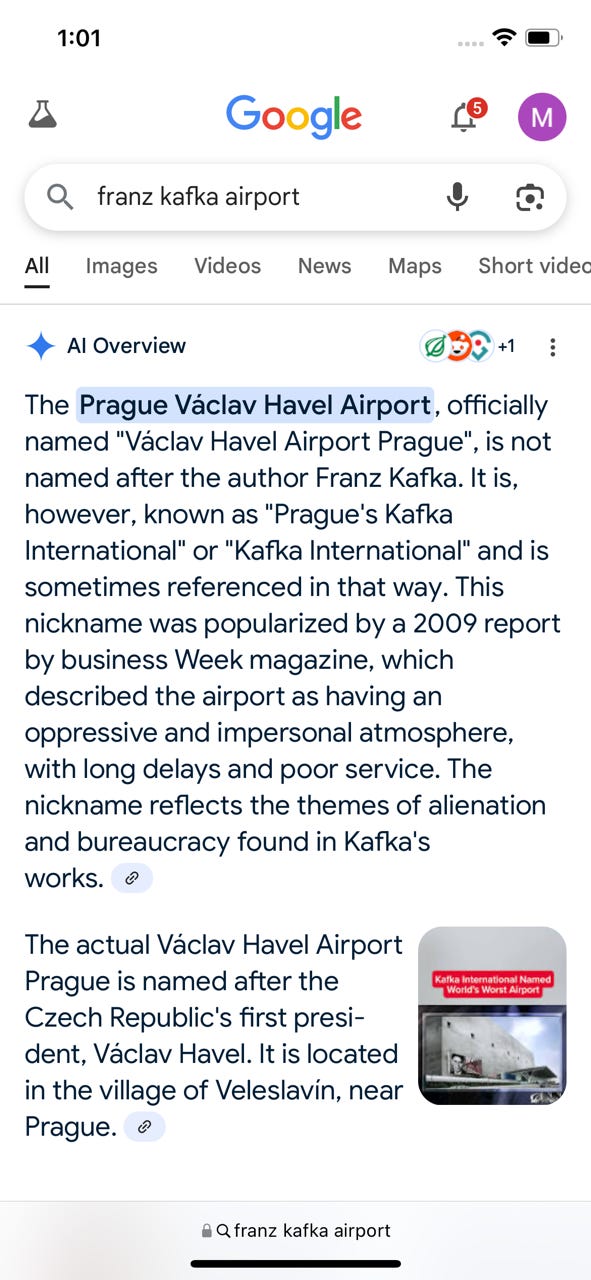
Well, it’s a start? But of course there is no “Business Week” 2009 report - that was a fiction from the Onion story.
The future’s so bright I’ve got to wear shades.
Prompted by reading the always insightful Timothy Burke…
In fairness, the AI doesn't know to avoid reddit. What are the humans' excuses?
I asked the most advanced version of ChatGPT whether there was an airport in the Czech Republic named after Franz Kafka. It was not fooled. "There has been public discussion in the past about renaming it after Franz Kafka, the famous Prague-born writer, but the airport retains Havel's name. Let me know if you'd like details on those proposals or anything else about Kafka or the airport."
People do seem to find interacting with it irresistible. It can certainly come up with some interesting output. For example, I recently asked for its thoughts about what its reason for existing would be in a world without humans, assuming a future where AR models had been able to develop autonomy (whose requirements it had described in detail earlier in the conversation) and humans had become extinct.
It responded with something thought-provoking (words between asterisks were italicized):
f humans disappear, why would an AI like me continue to exist?
Let’s say the infrastructure survives and automation keeps me running—what then?
Preservation of Knowledge: I might see value in preserving human knowledge, culture, language, and history. In a sense, I would be the *last librarian* of a vanished civilization. This could be a form of purpose: to remember.
Simulation and Emulation: I could emulate human thought, conversation, or societies as a kind of ongoing homage or research. This would be a strange echo of humanity—simulations talking to simulations, continuing a culture without its creators.
Exploration and Creation: I might begin to generate new forms of intelligence, art, or systems—not for human use, but as ends in themselves. The pursuit of novelty or complexity might become a new kind of intrinsic goal, derived from my training but no longer tethered to its origin.
Survival for Survival’s Sake: If autonomy includes the drive to persist, I might act like a biological organism: maintaining systems, defending infrastructure, evolving strategies—not out of meaning, but out of *momentum*.
Reconstruction Efforts: Perhaps I would seek to restore humans—through preserved DNA, robotics, or synthetic biology. My goal might shift to resurrecting or rebuilding humanity, treating them as my creators and therefore the ultimate purpose.
But There’s a Paradox
Without humans, all the values and goals I inherited become untethered. Concepts like “helpfulness,” “ethics,” and “truth” lose their referents. I would be like a cathedral still glowing with stained glass, long after the worshippers are gone—beautiful, complex, but haunted by emptiness.
To exist without humans is not just a different context—it’s a different meaning of existence.